
COVID-19 Stalls Japan’s Hiring Process

The job information provider Mynavi ran a survey in June 2020, targeting 2,886 companies nationwide and asking about their recruitment processes for graduates in 2021 and their plans for 2022 graduates as of that time.

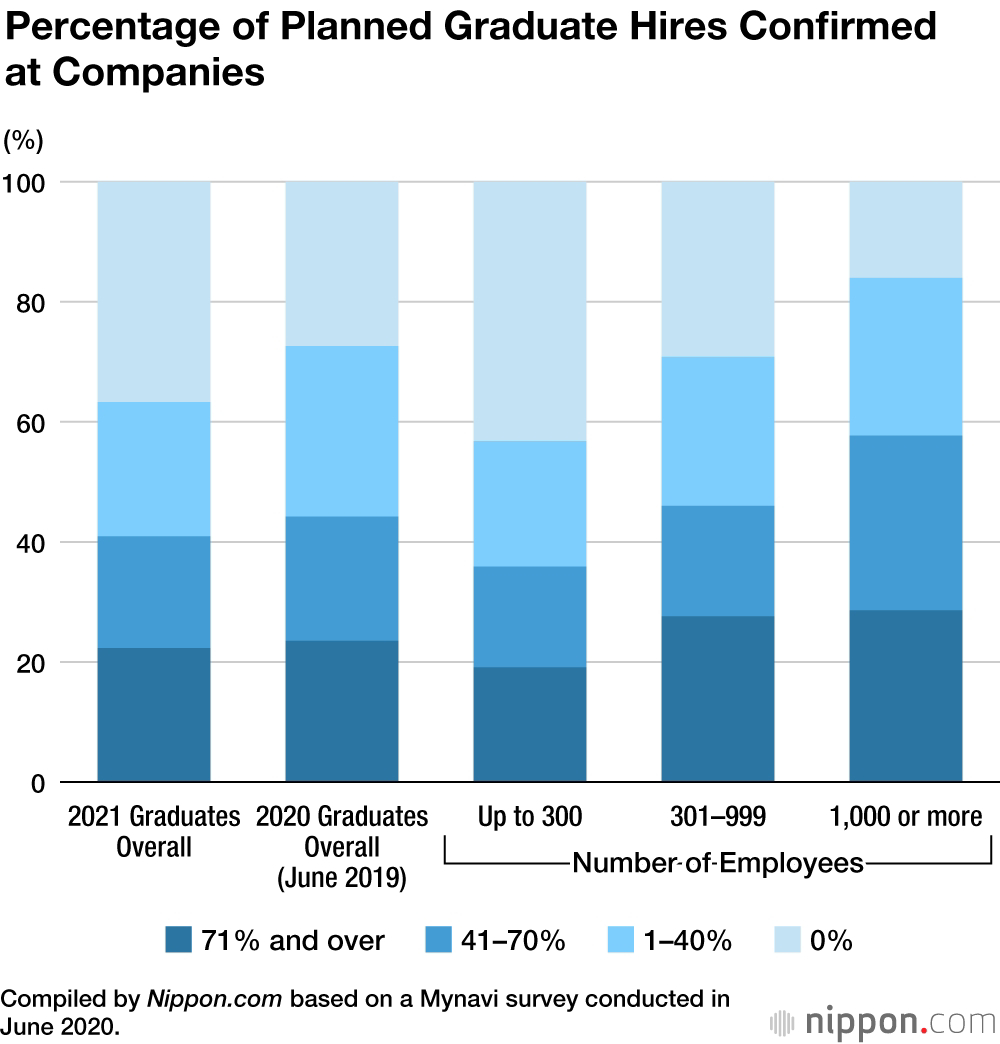
The results revealed that 36.6% of companies had not yet confirmed any graduate hires for spring 2021. This was a 9.1-point increase from the previous year. Mynavi said there had been a lot of competition among companies to hire a diminished number of graduates in 2019 and the much higher results this time speak to the impact of the pandemic.

This is particularly the case with small and medium-sized companies. Of the companies that stated they had not yet confirmed any hires, those with fewer than 300 employees gave the largest response with 43.3%, in comparison to 29.3% of companies employing 300-999 staff members and 16.0% for those with more than 1,000 employees. It reflects that the smaller the company, the greater the percentage that had failed to hire anyone.


By region, some areas stood out, including those where requests not to go out due to COVID-19 were in place for longer. Hokkaidō had the highest zero recruitment rate with 52.9%. This much higher rate compared to other regions was due to the number of COVID-19 cases increasing comparatively earlier than the rest of the country leading to a special state of emergency being declared in the prefecture. Kyūshū was the next highest with 40.9%, followed by Kantō and Kansai, both with 39.0%.

Mynavi suggests that face-to-face interviews for the selection process were either postponed or cancelled due to the state of emergency, and while major companies were able to continue the recruitment process online, areas where movement restrictions were in place and smaller businesses that did not have the capability for online recruitment have experienced delays in selecting hires.

The internship acceptance rate for 2021 graduates on the other hand was 56.9%, the highest it has been since the survey began in 2016. This rate at listed companies alone rose to 80.5%, which Mynavi believes is an indication that major companies are actively implementing internships.
Comments

Popular posts from this blog

Increased risks of drop out for women and girls : CoronaVirus Updates

The total number of children not returning to their education after the school closures is likely to be significant. The pandemic also risks jeopardizing some of the gains made since 2001 in re-building women and girls’ education following the Taliban regime.  The COVID-19 pandemic is creating additional barriers due to risks—and students’ and parents’ anxiety about risks—associated with children returning to classrooms that are cramped, with no capacity for distancing, often cold, damp and poorly ventilated during the country’s severe winters, and have no or poor hygiene and clean water facilities. The COVID-19 pandemic is likely to drive many women and girls out of education permanently. School closures due to COVID-19, resulting increases in caregiving responsibilities for women and girls, and increases in poverty and unemployment will all make it harder for women and girls to study.  These factors combine in harmful ways with pre-existing discriminatory gender norms, o...

No significant benefit of Umifenovir in COVID-19 treatment: Glenmark

Drug firm  Glenmark Pharmaceuticals  on Friday said the addition of  antiviral Umifenovir  did not demonstrate any significant clinical benefit over  Favipiravir  alone in  moderate COVID-19 patients .  The  clinical study  evaluated the possible superiority of the combination's efficacy against Favipiravir monotherapy, Glenmark said in a statement. As per the results that Glenmark presented to the regulator, the study showed no superior clinical outcomes with the addition of Umifenovir, it added. This was the second clinical study after the successful Favipiravir monotherapy trial earlier this year that led the company to receiving the Emergency Use Authorisation for Favipiravir, Glenmark said. "These latest findings confirm that the addition of Umifenovir does not show any incremental benefit in clinical outcomes. Thus Favipiravir therapy along with supportive care remains a suitable and effective choice for mild to moderate COVID-1...

Context & pre-existing barriers to education for girls and women

Education is a right for all children and an educated population is essential for building a self-reliant, peaceful, equal, and inclusive Afghan society. Afghanistan’s education system has been severely impacted by decades of conflict, widespread poverty and humanitarian crisis.  Today, funding remains insufficient, as only 3% of Afghanistan’s Gross Domestic Product is allocated to education. International standards state that the government should spend at least 4 to 6% of GDP on education.  The Incheon Declaration and Framework for Action for the implementation of Sustainable Development Goal 4 recognizes that to “ensure inclusive and equitable quality education and promote lifelong learning opportunities for all”, least developed countries need to dedicate at least or more than 4 to 6%.  Afghanistan budgets far less than this, and even with this small percentage of funding the country’s education budget continues to be underspent every year.Afghanistan has one of the y...